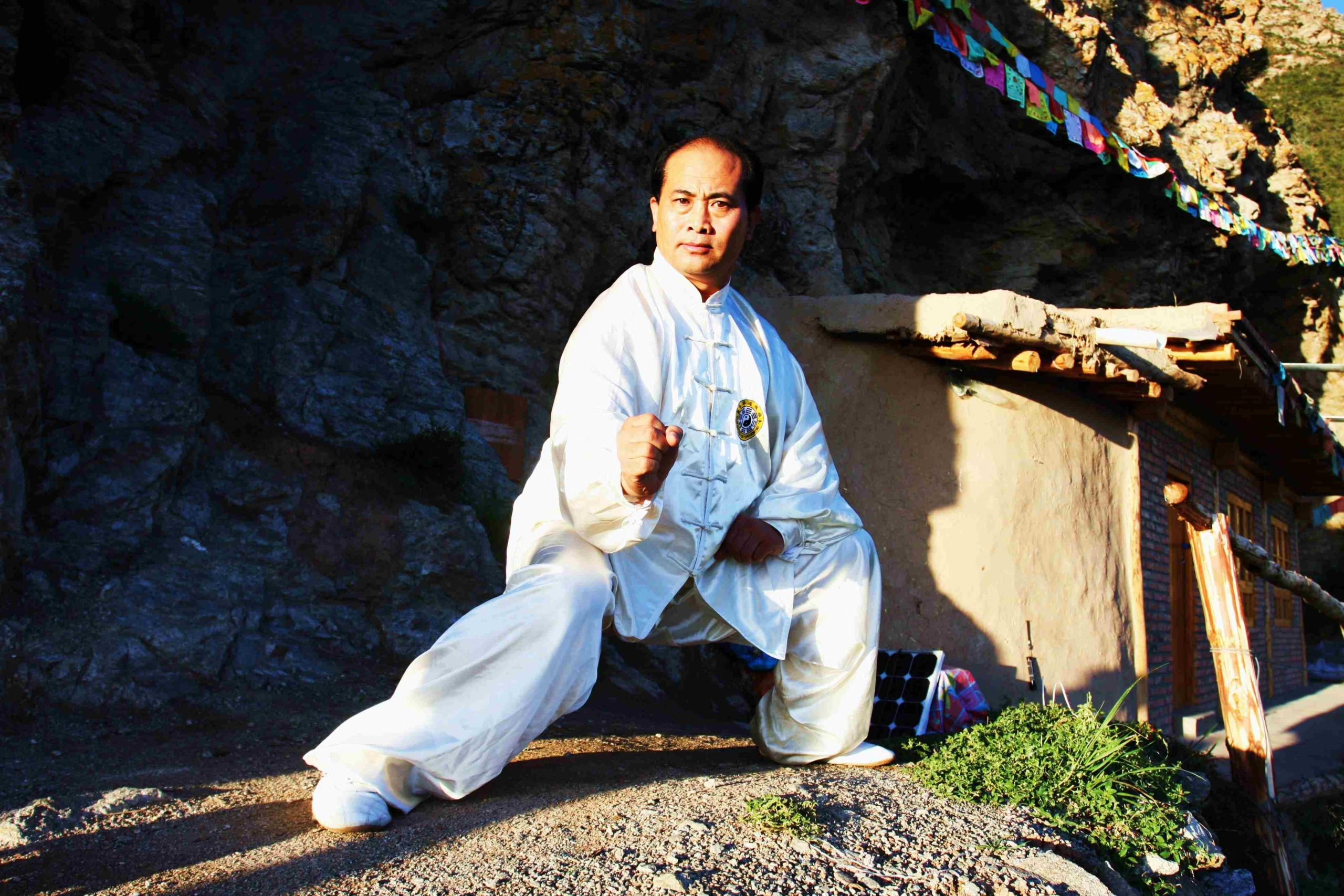
BEIJING, July 19 (WSH) — For Chinese martial arts master Duan Baohua, passing on kung fu means far more than teaching physical techniques. It is about passing on values, philosophy, discipline and a cultural tradition from one generation to the next.
Duan, president of the Chinese Liangyi Culture Research Association, head of the China Kung Fu Research Institute at Harvard University, and a representative inheritor of Liangyi Quan, an intangible cultural heritage of Henan Province, recently accepted Lan Jiajing as a new disciple.
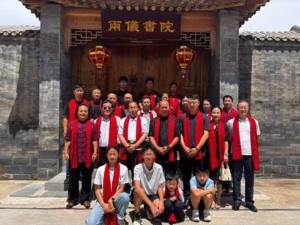
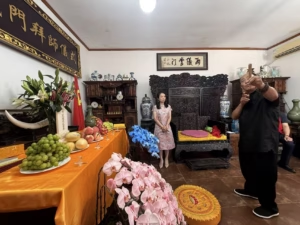
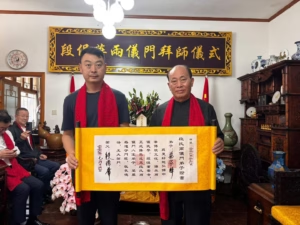
The traditional apprenticeship ceremony marked not only the beginning of a new master-disciple relationship, but also another chapter in the preservation and transmission of Liangyi Quan, an ancient Chinese martial arts tradition rooted in Shenqiu County in Zhoukou, central China’s Henan Province.
From a family tradition once passed down within a limited circle to a recognized form of provincial intangible cultural heritage, Liangyi Quan has gradually reached universities, professional institutions and international audiences.
In an interview with The Wall Street Herald, Duan discussed the meaning of apprenticeship, martial ethics, health and wellness, the philosophy behind Liangyi culture, and how Chinese kung fu can communicate more effectively with the world.
Apprenticeship Is About Passing on Values, Not Just Techniques
WSH: Lan Jiajing has formally become your disciple. What does the traditional master-disciple relationship mean to you?
Duan: Apprenticeship is first and foremost a form of cultural inheritance, and it also carries responsibility.
I have always said that martial ethics come before martial skills, and that one must cultivate the heart before practicing the fist.
When a person studies martial arts, the first thing he or she should learn is how to be a good person. No matter how advanced your kung fu may be, if you lack virtue, kindness and a sense of responsibility, then the true meaning of martial arts has been lost.
When I accept a disciple, I do not look only at talent. Character is even more important. Does this person respect teachers and tradition? Does this person have a sense of responsibility? Does he or she genuinely love traditional Chinese culture?
A master should pass on more than a set of movements or fighting techniques. A master should also pass on principles for how to live and conduct oneself.
That is why the tradition of lineage and mentorship has always been so important in Chinese martial arts.
Calling someone “Master” carries a very deep responsibility.
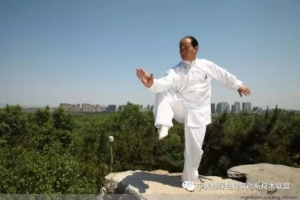
“We Learn the Fist, Cultivate the Heart and Understand Life”
WSH: Many people know Liangyi Quan for its distinctive techniques, including acupoint-related methods and internal practices. What do you consider the true essence of Liangyi Quan?
Duan: Liangyi Quan is much more than physical combat.
The concept of “Liangyi” comes from the I Ching, or Book of Changes: “The Supreme Ultimate generates the Two Forms.” It is about yin and yang, balance and transformation.
Liangyi Quan combines martial arts with ideas associated with traditional Chinese health practices, biomechanics, yin-yang philosophy and other dimensions of Chinese traditional culture.
I often say:
“We learn the fist,
we cultivate the heart,
we compare techniques,
we contemplate philosophy,
and at the heart of it all lies compassion.”
When you reach a deeper level of martial arts, you realize that the most important goal is not defeating someone else.
It is understanding yourself, controlling yourself and improving yourself.
A person with true kung fu should become more peaceful, not more aggressive.
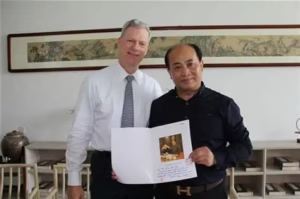
The Highest Realm of Martial Arts Is Not Fighting
WSH: Internationally, Chinese kung fu is often associated first with combat and fighting techniques. How do you understand the deeper spirit of Chinese martial arts?
Duan: In Chinese culture, the character “wu,” meaning martial, is traditionally associated with the idea of stopping conflict.
True martial arts are not about seeking confrontation.
We practice first to strengthen the body, then to protect ourselves, then to cultivate ourselves, and ultimately to cultivate the mind.
A person may possess great ability but choose not to harm others. A person may possess powerful skills but understand restraint. That is a higher level.
I have always believed that, ultimately, Chinese martial arts carry a message of peace.
You should have the ability to protect yourself and others, but the best outcome is to avoid conflict altogether.
The highest meaning of martial arts is respect for life, respect for others, commitment to justice and the protection of peace.
From a Family Tradition to Intangible Cultural Heritage
Liangyi Quan has deep roots in Shenqiu County, Zhoukou, Henan Province.
Like many traditional Chinese martial arts, some of its techniques were historically transmitted within families or through closely guarded master-disciple lineages.
Duan has sought to gradually open that tradition to a wider community.
WSH: Why did you decide to move away from the more closed approach to transmission practiced in the past?
Duan: Times have changed.
Many valuable traditions disappeared because people were too conservative about passing them on.
If something valuable is known by only a handful of people, one day it may simply disappear.
Traditional culture is not the private property of one individual. It belongs to our cultural heritage and should be passed on to future generations.
I gradually became convinced that anyone who genuinely loves Chinese culture, has good character and is willing to study seriously should be given an opportunity.
In 2009, Liangyi Quan was included on Henan Province’s list of representative intangible cultural heritage projects.
Since then, preserving, transmitting and promoting Liangyi culture has become an even more important part of Duan’s mission.
Today, his disciples and students can be found in China and overseas, taking a martial tradition once taught within a relatively closed circle into a more open and interconnected world.
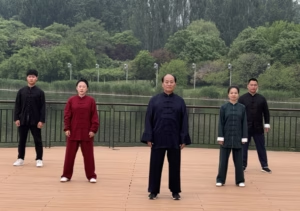
“True Mastery Comes From Self-Cultivation”
WSH: You once said, “A true master is cultivated, not merely trained.” What do you mean by that?
Duan: Training develops technique. Cultivation develops the person.
Technique is certainly important.
But a person does not reach a higher level simply by mastering a few movements or fighting techniques.
You must cultivate your character, your state of mind, your morality and your wisdom.
A martial artist must first learn to control his or her emotions.
If someone says something unpleasant and you immediately become angry, or if you lose control whenever something goes wrong, then no matter how advanced your physical skills are, you have not truly mastered yourself.
Ultimately, kung fu is about cultivating the heart and mind.
True strength comes from within.
Martial Arts and Wellness Share a Search for Balance
WSH: Liangyi culture also places considerable emphasis on health and wellness. How do you see the relationship between martial arts and health?
Duan: They are actually interconnected.
Liangyi emphasizes the balance of yin and yang.
The human body also requires balance.
Movement and stillness, hardness and softness, speed and slowness, breathing and strength — all must be balanced.
When people are young, they may think martial arts are mainly about strength and speed. As they grow older, they begin to understand that good martial arts must also teach you how to protect and care for your body.
Martial arts should not damage the body. They should help the body become more coordinated and balanced.
That is why Liangyi culture involves both self-protection and wellness.
Ultimately, the goal is to help people achieve a better balance of body, mind and spirit.
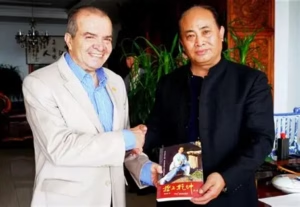
Taking Chinese Kung Fu to the World Requires Telling the Culture Behind It
Over the years, Duan has worked to bring Liangyi culture beyond Henan and introduce Chinese martial arts to wider domestic and international audiences.
He has participated in educational programs, professional exchanges and international cultural activities aimed at presenting not only martial techniques but also the cultural ideas behind them.
WSH: Chinese kung fu is already well known around the world. How can it be communicated more effectively to international audiences today?
Duan: We cannot simply demonstrate a few movements.
If you only perform acrobatics or a set of martial arts movements, international audiences may find it exciting, but they may not truly understand Chinese kung fu.
Behind Chinese kung fu lies a very deep culture.
Why do we talk about yin and yang?
Why do we emphasize the balance between hardness and softness?
Why do we speak of harmony between humanity and nature?
Why must martial arts be guided by ethics?
These are what make Chinese kung fu truly distinctive.
When we take Chinese martial arts to the world, we should not only “show the kung fu.” We should also explain the culture.
Through kung fu, we can help international audiences understand the I Ching, Chinese philosophy, and Chinese perspectives on life, nature, balance and peace.
That is when Chinese kung fu can truly become a meaningful form of international cultural communication.
When Martial Arts Meet Calligraphy
Beyond martial arts, Duan has also devoted years to Chinese calligraphy.
He has sought to incorporate the Liangyi concepts of yin and yang, solidity and emptiness, hardness and softness, movement and stillness into his calligraphic practice, developing what he describes as “Liangyi Yin-Yang Calligraphy.”
To Duan, martial arts and calligraphy share a common spirit.
A martial movement has rhythm and transition; so does the movement of the brush.
Martial arts emphasize changes between the substantial and the insubstantial; calligraphy explores variations in weight, intensity and rhythm.
Martial arts seek harmony between hardness and softness; calligraphy similarly balances strength with grace.
“Martial arts strengthen the body; culture cultivates the heart,” Duan said.
For him, the literary and the martial are not separate worlds. They are complementary expressions of Chinese culture.
A New Disciple, a New Responsibility to Carry the Tradition Forward
Lan Jiajing’s entry into the Liangyi lineage represents another continuation of the traditional master-disciple relationship.
For Duan, however, accepting a disciple is not simply about adding another name to a lineage. It means nurturing another future bearer of a cultural tradition.
Whether a tradition survives does not depend solely on the fame of one master. It depends on whether people are willing to learn, teach, understand and carry it forward generation after generation.
The journey of Liangyi Quan — from the countryside of Shenqiu to intangible cultural heritage recognition and increasingly international exchanges — reflects a broader challenge facing many forms of traditional Chinese culture today:
How can tradition be preserved without becoming closed to change?
How can skills be transmitted together with the values and philosophy behind them?
And how can Chinese culture engage with the world while preserving its own roots?
For Duan, the answer is simple: inheritance.
“The power of one person is limited,” he said. “What really matters is passing it from one generation to the next. As long as there are people willing to learn, to teach and to truly understand the culture behind it, its roots will remain alive.”
From one movement to another, from master to disciple, and from martial technique to cultural philosophy, the story of Duan Baohua and Liangyi culture continues.
With a new generation of disciples joining the tradition, Liangyi culture is also finding new people to carry it forward.
What endures through time is not merely a form of kung fu, but a culture, a philosophy and a spirit passed carefully from one generation to another.