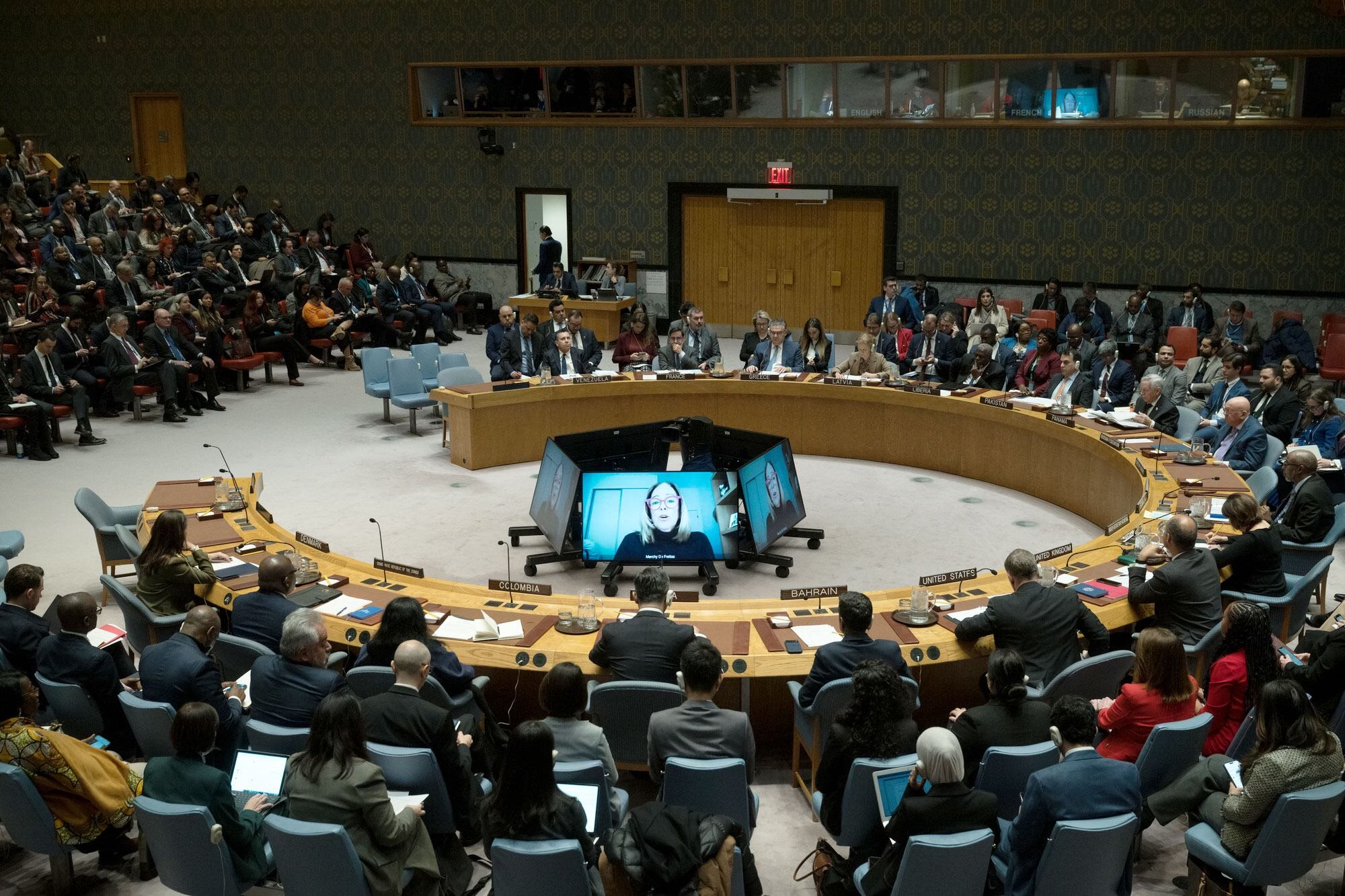
UNITED NATIONS, Jan. 5 (WSH) — The United Nations Security Council met in emergency session on Monday amid sharply altered diplomatic circumstances following U.S. military strikes in Caracas and the seizure of Venezuelan President Nicolás Maduro, an action that has exposed deep divisions among Council members over the limits of force, sovereignty, and accountability under international law.
The meeting, held under the agenda item “Threats to international peace and security,” came as Maduro appeared in a U.S. federal court in New York just miles from UN headquarters. While Washington framed the operation as a narrowly targeted law-enforcement action, a number of states warned that the precedent set by the removal of a sitting head of state through unilateral force could have far-reaching consequences for the international system.
In opening remarks delivered on behalf of Secretary-General António Guterres, senior UN officials cautioned that international peace and security depend on the consistent application of the UN Charter, including the prohibition on the use of force against the political independence and territorial integrity of states.
U.S.: Arrest, not aggression
The United States rejected characterizations of the Jan. 3 operation as an act of war, describing it instead as a law-enforcement action supported by military assets to execute long-standing criminal indictments.
U.S. Ambassador Michael G. Waltz told the Council that Maduro was not a legitimate head of state following Venezuela’s disputed 2024 election and argued that the operation was justified by the need to combat narcotics trafficking and transnational organized crime threatening regional security.
“There is no war against Venezuela or its people,” Waltz said. “This was a law-enforcement operation in furtherance of lawful indictments that have existed for decades.”
He cited historical precedent, including the 1989 arrest of Panama’s former leader Manuel Noriega, and emphasized that U.S. forces were not occupying Venezuelan territory.
Venezuela: Sovereignty breached
Venezuela’s ambassador to the United Nations, Samuel Moncada, sharply disputed the U.S. account, accusing Washington of carrying out an unlawful armed attack that resulted in civilian and military casualties and the forcible removal of the country’s president and first lady.
Moncada argued that the operation violated Article 2 of the UN Charter, which prohibits the use of force against the sovereignty of states, and warned that the action risked legitimizing external intervention driven by access to natural resources.
He called on the Security Council to condemn the operation, demand the release and return of Maduro and his wife, reaffirm the principle of non-acquisition of resources by force, and take steps to de-escalate tensions and protect civilians.
Regional and global reactions
Several Latin American countries, including Colombia, Brazil, Mexico, Chile, and Panama, expressed concern that unilateral military action could destabilize the Western Hemisphere and undermine the region’s long-standing commitment to resolving disputes peacefully.
Colombia, speaking in its first intervention as a newly elected Council member, rejected unilateral uses of force and warned that civilians invariably bear the greatest cost. Brazil described the bombing of a capital city and seizure of a head of state as crossing an “unacceptable line,” while Mexico stressed that externally imposed regime change violates international law regardless of political disagreements.
European states adopted a more cautious tone. The United Kingdom, France, and Denmark acknowledged the gravity of Venezuela’s internal crisis and the need to address organized crime and human rights abuses, but emphasized that accountability must be pursued through lawful, multilateral means consistent with the UN Charter.
A smaller group of regional states, including Argentina and Paraguay, voiced support for the U.S. action, arguing that Maduro’s removal could open a path toward restoring democracy, the rule of law, and human rights in Venezuela.
Charter credibility under scrutiny
China and Russia delivered some of the strongest criticism, describing the U.S. operation as armed aggression and warning against what they characterized as the normalization of unilateral force. Their concerns were echoed by several states outside the Americas, including South Africa, Pakistan, Iran, and Uganda, which cautioned that selective application of international law risks undermining the credibility of the collective security system.
Several delegations framed the crisis as a test of whether the principles of the UN Charter apply equally to all states, particularly with respect to head-of-state immunity and the prohibition on the use of force.
No Council action
At the conclusion of the meeting, no draft resolution or formal Council product was proposed, underscoring entrenched divisions among members. The absence of action recalled earlier moments in the Council’s history, including the U.S. intervention in Panama in 1989, when condemnation efforts were ultimately blocked by vetoes.
As Venezuela enters a period of heightened uncertainty, diplomats and analysts alike warned that the broader implications of the crisis may extend well beyond the country itself, raising unresolved questions about the future boundaries of sovereignty, the enforcement of international norms, and the role of power in an increasingly polarized global order.