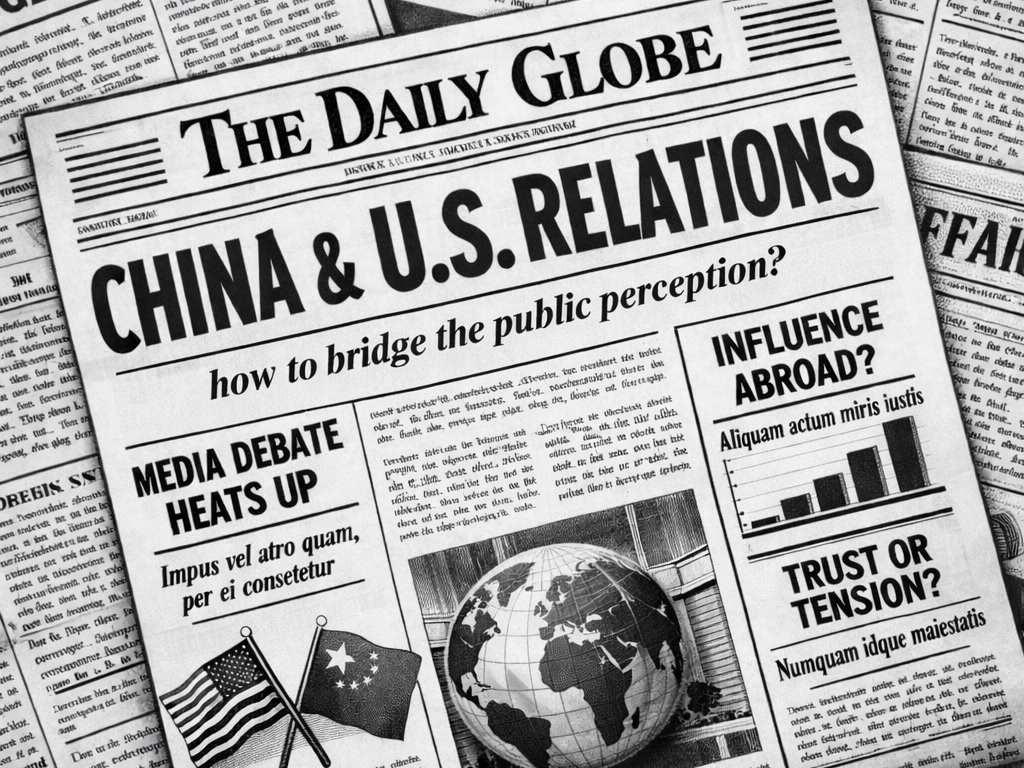
Over the past decades, media and political messaging have played a crucial role in shaping how societies perceive one another. In some cases, media narratives help build understanding across borders; in others, they deepen mistrust and distance. Working in communications on U.S.–China relations, my work focuses on explaining China to American audiences and introducing American perspectives to Chinese readers. Yet in practice, media narratives in both countries often push public perceptions further apart rather than bringing them closer together.
Differences in content accessibility, narrative framing, and media systems shape how publics understand U.S.–China relations, and these dynamics frequently reinforce distance rather than connection.
Limited Cross-Border Content Accessibility
One major challenge lies in the limited circulation of media content across national and linguistic boundaries. Stories that resonate strongly with domestic audiences in one country often fail to travel effectively to the other. Cultural references, political assumptions, and narrative conventions differ substantially between the United States and China. As a result, even when similar events are reported, they are framed and interpreted through distinct lenses.
A recent exchange tells how media-specific language can generate cross-national misunderstanding. A CGTN journalist asked Scott Bessent about the so-called “Kill Line” (斩杀线), a term circulating widely in Chinese media discourse to describe the precarious financial condition in which households have little or no margin for economic shocks. The clip went viral on Chinese social media platforms because Bessent appeared not to fully grasp the term and was unable to provide a substantive response, as the term has no equivalent in mainstream U.S. political or journalistic usage. This evasive answer was in fact a linguistic and cultural mismatch, showing how concepts embedded in one national media environment may fail to translate meaningfully into another.
The deeper issue lies not in the term itself, but in the absence of a shared interpretive context. Expressions such as “Kill Line” derive their meaning from specific media ecosystems; once removed from that environment, their significance becomes opaque rather than transferable. This asymmetry in narrative framing increases informational distance between audiences. Over time, such divergent framings complicate mutual understanding and reinforce the perception that the two societies are moving in opposite directions.
Media-Driven Misconceptions
Beyond language and cultural barriers, mutual mistrust shapes public narratives. Positive stories about one country published in the other’s media are often viewed with suspicion. In the United States, coverage perceived as favorable to China may be labeled “propaganda.” In China, critical U.S. media reporting can be seen as politically motivated or hostile. Especially, when U.S. media outlets report on human rights, Tibet, or Xinjiang, such coverage is often interpreted by Chinese audiences as part of a broader political agenda rather than as independent journalism. This skepticism makes it difficult for audiences to accept alternative perspectives.
The 2023 Biden–Xi meeting at the APEC summit reflects this divergence. Based on a rough estimate of headlines from major outlets following this meeting, 70% Chinese coverage framed the meeting as a turning point in bilateral relations and prospects for cooperation, while U.S. outlets foregrounded risk or skepticism in approximately 65% of reporting. Headlines such as “Chinese President Xi’s ‘siren call’ to U.S. business hits a wall of skepticism” and “U.S. investors remain wary of China’s business climate amid economic slowdown and regulatory crackdowns” captured this tone. Although both sides reported on the same meeting, the way they framed the news sharply different public impressions, which reinforced the perceptual distance rather than mutual understanding.
These dynamics are intensified by selective exposure. Audiences tend to consume content that aligns with their existing beliefs. Algorithms and social media amplify this tendency by politically reinforcing narratives. Over time, this creates echo chambers in which individuals encounter only information that confirms their assumptions about the other country. These cycles reinforce stereotypes and make it harder to challenge new narratives.
Differences in Media Systems and Credibility
Differences in media systems also shape how people judge what they see and hear. There are differing conceptualizations of the role of the media in society between U.S. and China. In the United States, most media outlets are privately owned and commercially driven. This creates a wide range of voices, but also strong competition for attention, which can push coverage toward conflict and political division. In China, the media system is more centralized and state-regulated, reinforcing a public notion of the state as a benign parental figure and resulting in less criticism of the state in mainstream media. Therefore, these differences influence not only what stories are covered, but how audiences assign credibility.
These credibility dynamics become quite visible in U.S. debates over foreign state-backed media. There is a report around the scale of overseas media spending -“CGTN, a state broadcast company, reported more than half of the $280 million” associated with foreign media outreach. In U.S. academic and policy debates, these figures are typically read as overseas influence campaigns, contributing to concerns that state-backed media may shape public opinion about China or indirectly affect U.S. domestic politics. Whether or not such influence is proven in practice, the perception itself can impact media credibility and frames how content is received.
Conclusion
State and mainstream media do not simply report on U.S.–China relations; they actively shape how the relationship is understood by the public. Differences in narrative framing, content circulation, and institutional credibility often widen rather than narrow the perception gap between the two societies. Even when cooperation exists, it is frequently overshadowed by stories of competition, risk, and distrust. When narratives are filtered through incompatible political and cultural lenses, misinterpretation becomes routine rather than exceptional. Over time, these accumulated misunderstandings harden into assumptions about the other side’s motives and character.
In an era of strategic rivalry, media may not determine foreign policy, but it strongly influences the public climate in which policy is made. If U.S.–China relations are to avoid becoming a self-fulfilling cycle of suspicion, greater attention must be paid to how information travels across borders—and how meaning is lost or distorted along the way. The question is not whether media shapes public perception, but whether it will continue to reinforce division or can be leveraged to sustain space for dialogue and mutual understanding amid deepening competition.
(The views expressed in this article are those of the author.)

Jincheng Zhang is Senior Communications Associate at the National Committee on U.S.–China relations, with a focus on media narratives and public perception. She holds both a master’s degree and a bachelor’s degree in Communication from the University of Washington.